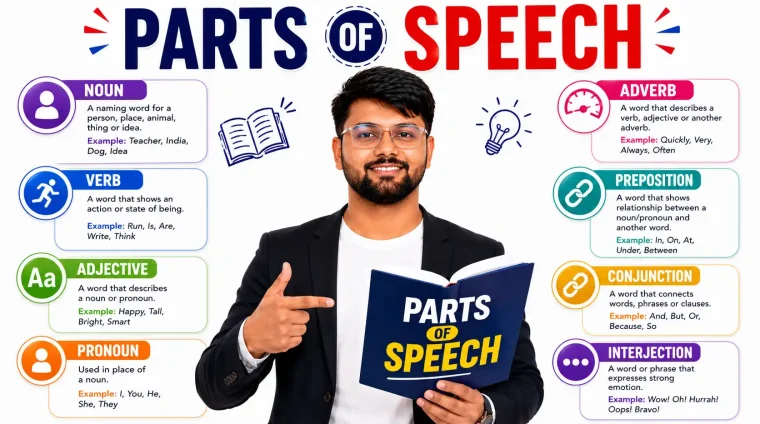
Parts of Speech: The Complete Guide to English Grammar
Introduction
The Parts of Speech are the foundation of the English language. Every sentence we read, write, or speak is built using words that perform specific functions. Understanding these functions is essential for mastering English grammar, improving communication skills, and developing confidence in both spoken and written English.
Whether you are a school student, a college learner, a competitive exam aspirant, or a working professional, learning the parts of speech is one of the most important steps toward becoming fluent in English. It helps you create grammatically correct sentences, understand complex texts, and express your ideas with clarity and confidence.
This comprehensive guide explains each part of speech in detail, along with definitions, examples, practical tips, and common mistakes to help you strengthen your grammar from the basics.
What Are Parts of Speech?
Parts of speech are categories that classify words according to the role they perform in a sentence. Every word belongs to one or more categories depending on how it is used.
For example, consider the sentence:
The intelligent student answered every question confidently.
Each word has a different role:
- The → Article (Determiner)
- Intelligent → Adjective
- Student → Noun
- Answered → Verb
- Every → Determiner
- Question → Noun
- Confidently → Adverb
By identifying these roles, learners understand how English sentences are formed.
Why Are Parts of Speech Important?
Learning the parts of speech helps learners:
- Build grammatically correct sentences
- Improve speaking and writing skills
- Increase vocabulary naturally
- Understand sentence structure
- Prepare for competitive examinations
- Improve reading comprehension
- Write professional emails and reports
- Develop confidence in communication
Strong grammar begins with a clear understanding of these basic building blocks.
The Eight Parts of Speech
English grammar consists of eight primary parts of speech:
- Noun
- Pronoun
- Verb
- Adjective
- Adverb
- Preposition
- Conjunction
- Interjection
Let us study each one in detail.
1. Noun
Definition
A noun is the name of a person, place, thing, animal, or idea.
Examples
- Rahul
- Delhi
- Teacher
- Book
- Computer
- Happiness
- Water
- Friendship
Example Sentences
- Rahul is a good student.
- Delhi is the capital of India.
- The book is on the table.
- Honesty is the best policy.
Types of Nouns
Proper Noun
Names of specific people or places.
Examples:
- India
- London
- Riya
Common Noun
General names.
Examples:
- City
- Teacher
- Boy
Collective Noun
Names of groups.
Examples:
- Team
- Family
- Crowd
Material Noun
Names of substances.
Examples:
- Gold
- Wood
- Cotton
Abstract Noun
Names of qualities or ideas.
Examples:
- Love
- Freedom
- Wisdom
2. Pronoun
Definition
A pronoun replaces a noun to avoid repetition.
Examples
- I
- We
- He
- She
- It
- They
- You
Example Sentences
- Riya is intelligent. She studies every day.
- Rahul lost his pen. He found it later.
Types of Pronouns
- Personal Pronoun
- Demonstrative Pronoun
- Relative Pronoun
- Reflexive Pronoun
- Possessive Pronoun
- Interrogative Pronoun
- Indefinite Pronoun
3. Verb
Definition
A verb expresses an action, occurrence, or state of being.
Examples
- Run
- Write
- Study
- Sleep
- Eat
- Is
- Are
Example Sentences
- She writes beautifully.
- They are playing football.
- Birds fly in the sky.
- The baby is sleeping.
Types of Verbs
- Main Verb
- Helping Verb
- Modal Verb
- Transitive Verb
- Intransitive Verb
- Linking Verb
4. Adjective
Definition
An adjective describes or modifies a noun or pronoun.
Examples
- Beautiful
- Tall
- Intelligent
- Honest
- Blue
- Large
Example Sentences
- She is a beautiful singer.
- The tall building is new.
- He bought a blue car.
Types of Adjectives
- Descriptive
- Quantitative
- Demonstrative
- Possessive
- Interrogative
- Proper
5. Adverb
Definition
An adverb modifies a verb, adjective, or another adverb.
It usually tells:
- How
- When
- Where
- How often
- To what extent
Examples
- Quickly
- Slowly
- Carefully
- Yesterday
- Always
- Very
Example Sentences
- She sings beautifully.
- He works hard.
- They arrived yesterday.
- The train moved slowly.
6. Preposition
Definition
A preposition shows the relationship between a noun (or pronoun) and another word in the sentence.
Examples
- In
- On
- At
- Under
- Behind
- Between
- Before
- After
- Across
- Through
Example Sentences
- The book is on the table.
- She lives in Mumbai.
- The cat is under the chair.
- We walked through the park.
7. Conjunction
Definition
A conjunction joins words, phrases, or clauses.
Examples
- And
- But
- Or
- Because
- Although
- Since
- Yet
- So
Example Sentences
- Rahul and Mohan are friends.
- She studied hard, so she passed.
- I wanted to go, but it was raining.
Types
- Coordinating Conjunction
- Subordinating Conjunction
- Correlative Conjunction
8. Interjection
Definition
An interjection expresses sudden emotions or feelings.
Examples
- Wow!
- Hurrah!
- Alas!
- Oh!
- Ouch!
- Bravo!
Example Sentences
- Wow! That is amazing.
- Hurrah! We won the match.
- Alas! He failed the examination.
- Ouch! That hurts.
Quick Summary Table
| Part of Speech | Function | Example |
|---|---|---|
| Noun | Names a person, place, thing, or idea | Student |
| Pronoun | Replaces a noun | He |
| Verb | Shows action or state | Run |
| Adjective | Describes a noun | Beautiful |
| Adverb | Modifies a verb, adjective, or adverb | Quickly |
| Preposition | Shows relationship | In |
| Conjunction | Connects words or clauses | And |
| Interjection | Expresses emotion | Wow! |
Common Mistakes Students Make
Many learners confuse adjectives with adverbs, misuse prepositions, or choose incorrect pronouns. These errors can affect both writing and speaking. Regular reading, grammar exercises, and sentence practice help build accuracy over time. Understanding the function of each part of speech before memorizing rules makes learning easier and more effective.
Tips to Master Parts of Speech
- Learn one part of speech at a time.
- Read English newspapers and books daily.
- Observe how words are used in sentences.
- Practice writing short paragraphs.
- Solve grammar exercises regularly.
- Learn new vocabulary in context.
- Speak English every day to reinforce grammar naturally.
- Review your mistakes and correct them.
Parts of Speech in Competitive Exams
Questions related to parts of speech are frequently asked in competitive examinations such as SSC, Banking, Railways, UPSC, State PSCs, Defence exams, and various entrance tests. A strong understanding of these concepts helps candidates answer grammar-based questions, improve error detection skills, complete sentence improvement tasks, and perform better in English language sections.
Conclusion
The Parts of Speech are the backbone of English grammar. They help us understand how words function together to create meaningful and grammatically correct sentences. By mastering nouns, pronouns, verbs, adjectives, adverbs, prepositions, conjunctions, and interjections, learners develop a solid grammatical foundation that supports effective communication in every aspect of life.
Consistent practice, regular reading, and applying these concepts in everyday conversations and writing will gradually improve your fluency and confidence. Remember, every journey toward mastering English begins with understanding its basic building blocks—and the parts of speech are the first and most essential step.
- 1 Section
- 1 Lesson
- 365 Days
- Parts Of SpeechParts of Speech are the building blocks of the English language and form the foundation of effective communication. Every word in a sentence has a specific function, and understanding these functions is essential for mastering English grammar. The eight parts of speech—**Noun, Pronoun, Verb, Adjective, Adverb, Preposition, Conjunction,** and **Interjection**—help us identify how words relate to one another and how sentences are constructed. A strong understanding of these concepts enables learners to write accurately, speak confidently, and comprehend English more effectively. Whether you are a school student, a competitive exam aspirant, or a professional looking to improve your language skills, mastering the parts of speech will significantly enhance your grammar, vocabulary, sentence structure, and overall communication ability. This knowledge serves as the first step toward achieving fluency and success in English.1